
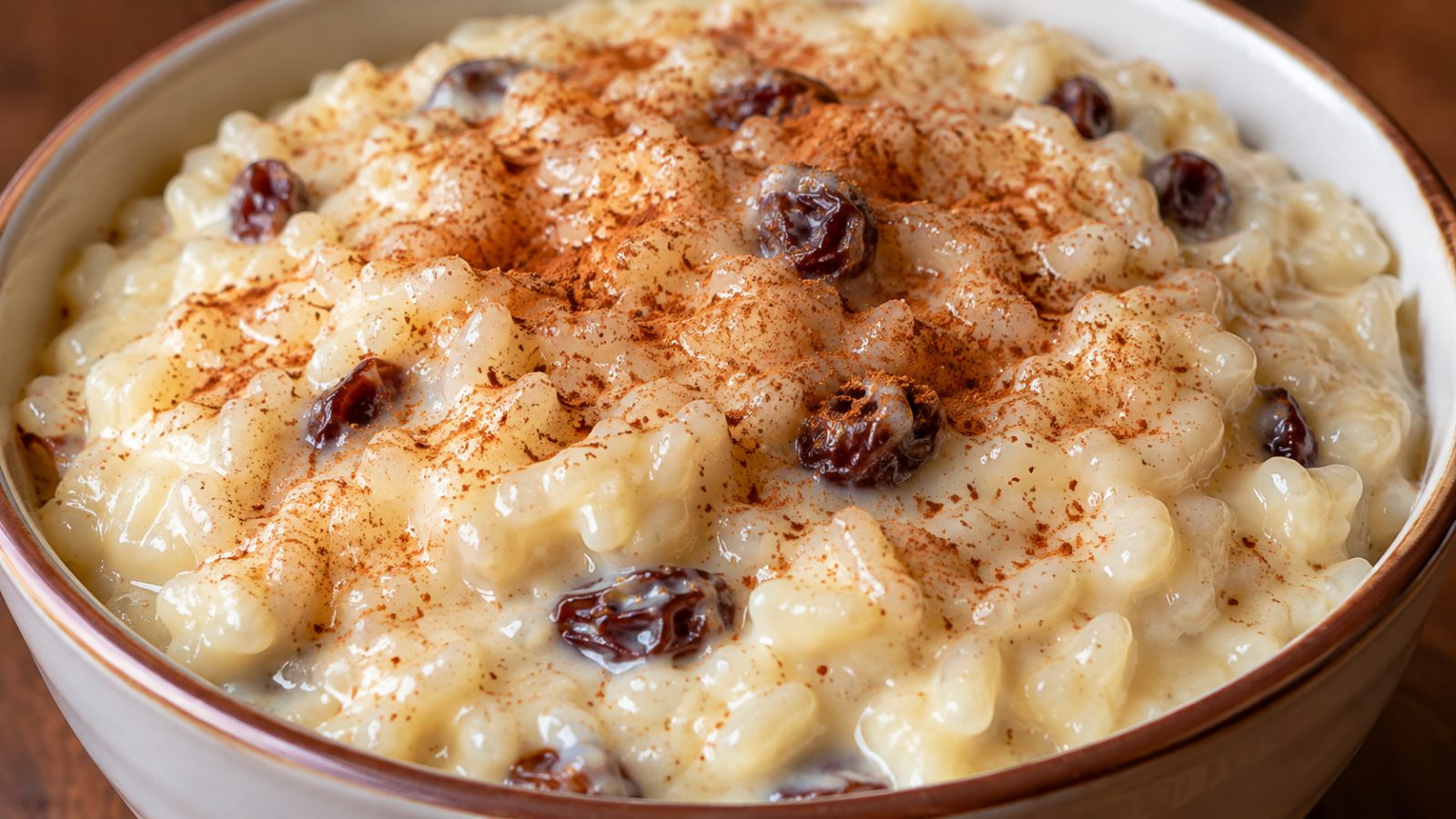
A proper rice pudding should be creamy without turning gluey, tender without becoming mush, and rich enough to taste like dessert without relying on excessive sugar. Whole milk, short- or medium-grain rice, gentle heat, and patient stirring give you that old-fashioned custard-like texture.
This version cooks the rice directly in milk so the starch released from the grains naturally thickens the pudding. Eggs add richness near the end, while vanilla, cinnamon, and a little butter round out the flavor.
Ingredients
- 3/4 cup (150 g) short- or medium-grain white rice
- 4 cups (960 ml) whole milk, divided
- 1/2 cup (100 g) granulated sugar
- 1/4 teaspoon fine salt
- 2 large eggs
- 1 teaspoon pure vanilla extract
- 2 tablespoons unsalted butter
- 1/2 teaspoon ground cinnamon, plus more for serving
- 1/3 cup (50 g) raisins, optional
- 1/4 teaspoon ground nutmeg, optional
How to Make OLD-FASHIONED RICE PUDDING
Step 1: Cook the Rice Gently in Milk
Combine the rice, 3 1/2 cups of the milk, sugar, and salt in a heavy-bottomed saucepan.
Set the pan over medium heat and bring the mixture just to a gentle simmer, stirring regularly so the milk does not scorch on the bottom.
Once simmering, reduce the heat to low.
Cook uncovered for about 25 to 35 minutes, stirring every few minutes. The rice should become very tender while the milk gradually thickens around it.
As the pudding gets thicker, stir more frequently. The starch settles easily on the bottom of the pan during the final stage and can burn if left undisturbed.
Do not let the mixture boil aggressively. Hard boiling can make the milk separate and can cause the rice to cook unevenly.
If the rice becomes tender before the pudding has thickened enough, continue cooking gently until the liquid reaches a loose, creamy consistency.
Step 2: Temper the Eggs
In a medium bowl, whisk the eggs with the remaining 1/2 cup milk until smooth.
Slowly ladle about 1 cup of the hot rice mixture into the eggs while whisking constantly.
This gradual addition raises the temperature of the eggs without scrambling them.
Pour the tempered egg mixture back into the saucepan while stirring continuously.
Cook over low heat for another 3 to 5 minutes.
Do not let the pudding boil after adding the eggs. High heat can curdle them and leave small cooked pieces throughout the pudding.
The mixture is ready when it coats the back of a spoon but still flows easily. Rice pudding thickens considerably as it cools, so remove it from the heat while it still looks slightly looser than your desired final consistency.
Step 3: Finish and Cool
Remove the saucepan from the heat.
Stir in the vanilla, butter, cinnamon, and optional nutmeg.
If using raisins, stir them in while the pudding is still hot. They will soften and absorb some of the flavored milk as the pudding rests.
Let the pudding stand for about 10 minutes before serving warm.
For chilled pudding, transfer it to a bowl and press plastic wrap directly against the surface to prevent a skin from forming. Refrigerate for at least 2 hours.
If the chilled pudding becomes thicker than you like, stir in a tablespoon or two of cold milk before serving.
A well-made OLD-FASHIONED RICE PUDDING should remain spoonable and creamy, with individual rice grains still visible inside the custard rather than dissolving into a paste.
What to Serve With OLD-FASHIONED RICE PUDDING
Rice pudding works well warm or chilled, and simple toppings usually suit it better than heavy additions.
A dusting of cinnamon or freshly grated nutmeg adds warmth without changing the texture.
For contrast, serve it with fresh berries, poached pears, baked apples, or sliced bananas.
A small spoonful of berry compote works especially well with chilled pudding because its acidity balances the rich milk and sugar.
Toasted almonds, pecans, or walnuts add crunch. Add them immediately before serving so they remain crisp.
For a richer dessert, finish each serving with a spoonful of softly whipped cream.
OLD-FASHIONED RICE PUDDING Nutrition Information
Approximate nutrition per serving, based on 6 servings without raisins:
- Calories: 310
- Protein: 9 g
- Carbohydrates: 46 g
- Fat: 10 g
- Saturated fat: 6 g
- Sugar: 27 g
- Fiber: 1 g
- Sodium: 170 mg
Nutrition values vary according to the milk, rice, serving size, and optional additions used.
FAQs
What type of rice is best for rice pudding?
Short- or medium-grain white rice gives the creamiest result because it releases more starch than long-grain rice.
Arborio rice also works well and creates an especially rich texture.
Long-grain rice can be used, but the pudding will generally be looser and the grains more separate.
Should I rinse the rice first?
For this style of pudding, do not rinse it heavily.
The surface starch on the rice helps thicken the milk naturally.
If the rice is visibly dusty, a very quick rinse is fine, but repeated rinsing removes starch that contributes to the creamy texture.
Why is my rice pudding too thick?
Rice continues absorbing liquid after cooking, especially as it cools.
Stir in a small amount of milk until the pudding returns to the consistency you want.
This is particularly useful for refrigerated leftovers.
Why is my pudding too thin?
It probably needs more cooking time.
Keep it over low heat and stir regularly until enough liquid evaporates and the rice releases more starch.
Remember that the pudding thickens during cooling, so avoid reducing it until it becomes stiff in the saucepan.
Can I make rice pudding without eggs?
Yes.
The rice starch alone can thicken the pudding. Simply omit the eggs and cook the milk and rice a little longer until creamy.
The egg-free version will be slightly less custard-like but still rich and smooth.
Why did the eggs scramble?
The eggs were heated too quickly or the pudding boiled after they were added.
Temper the eggs gradually with hot pudding before returning them to the saucepan, then keep the heat low.
Can I use cooked leftover rice?
Yes, but the method changes.
Use about 2 cups of cooked rice and simmer it with approximately 2 1/2 to 3 cups of milk, sugar, and salt until creamy.
Because cooked rice has already released much of its starch, the final texture may be slightly less silky than pudding made from raw rice.
Can I use evaporated milk?
Yes.
Replace part of the whole milk with evaporated milk for a richer flavor.
A good starting point is 1 cup evaporated milk plus 3 cups whole milk.
Using only evaporated milk can make the pudding very rich and noticeably sweeter in flavor.
Are raisins traditional?
Raisins are common in many older versions, but they are optional.
Golden raisins tend to be softer and slightly sweeter, while dark raisins provide a stronger dried-fruit flavor.
Add them near the end so they stay plump rather than breaking down.
Can I make this dairy-free?
Yes.
Full-fat coconut milk or a creamy oat milk works best because both provide enough body to produce a satisfying texture.
The flavor will change depending on the milk used, and coconut milk will give the pudding a noticeable coconut character.
How long does rice pudding keep?
Store it in an airtight container in the refrigerator for up to 4 days.
The pudding will continue thickening as it sits. Stir in a little milk before serving if needed.
Can rice pudding be reheated?
Yes.
Reheat it gently over low heat or in short microwave intervals.
Add a splash of milk while reheating and stir frequently so the pudding becomes creamy again without scorching.
Can I freeze rice pudding?
You can, but freezing changes the texture.
The milk can separate slightly and the rice may become softer after thawing.
For the best result, refrigerate rather than freeze it and eat it within 4 days.